

Most people don’t fail at their careers because they lack ambition. They fail because the gap between where they are today and where they want to be in ten years feels too wide to cross. That’s exactly why understanding how can short term goals best lead towards accomplishing long term career goals matters so much. The truth is simple: big career dreams rarely happen in one giant leap. They happen in small, deliberate steps that stack on top of each other until, one day, you look back and realize you’ve arrived somewhere you once thought was years away.
This guide breaks down exactly how that process works, in plain language, with real examples you can apply starting this week.
What Are Short-Term and Long-Term Career Goals, Really?
Before you can connect the two, it helps to know what each one actually means and why they exist for different reasons.
Short-Term Goals Defined
Short-term goals are the tasks and milestones you can realistically complete within a few days, weeks, or months. They’re specific, they’re close enough to see clearly, and they give you quick feedback on whether you’re moving in the right direction. Career advisors often describe short-term career goals as objectives that keep your day-to-day work focused while still supporting the bigger picture.
Examples include:
- Finishing an online course
- Improving a specific work skill
- Building your professional network by attending events
- Updating your resume and LinkedIn profile
- Asking for feedback from a manager
Long-Term Goals Defined
Long-term goals are the destination. They’re broader, more ambitious, and usually take a year or more, sometimes several years, to reach. They answer the “why” behind everything you’re doing right now. When you think about long-term career goals, you’re really thinking about the kind of professional, and the kind of life, you eventually want to build.
Examples include:
- Becoming a senior manager or director
- Switching industries or launching a business
- Earning a specialized certification or advanced degree
- Reaching a specific income level
- Building a reputation as an expert in your field
How Can Short-Term Goals Best Lead Towards Accomplishing Long-Term Career Goals?
This is the core question, so let’s answer it directly. Short-term goals work best as a bridge, not a detour. They’re only useful when each one is chosen because it moves you a step closer to the bigger picture, not just because it feels productive in the moment.
Here’s how that bridge actually gets built.
Break the Big Vision Into Smaller Milestones
A long-term goal like “become a marketing director” is too large to act on directly. There’s nothing you can literally do today that finishes it. So the goal needs to be broken into pieces small enough to start immediately.
Working backward from the destination is one of the most reliable ways to do this. Career counselors frequently recommend identifying the end goal first, then mapping the milestones that sit between where you are now and where you want to be, since each milestone becomes its own short-term goal with a deadline attached.
Use Short-Term Wins to Build Momentum and Confidence
Progress fuels motivation more than motivation fuels progress. When you complete a short-term goal, even a small one, you get proof that your plan is working. That proof matters more than people expect. A string of small wins builds the confidence needed to tackle the next, slightly bigger, challenge.
This is also why short-term goals should be genuinely achievable. If every goal feels like a stretch, you’ll burn out before you get anywhere near the long-term target.
Let Short-Term Goals Test and Refine Your Direction
Not every long-term goal survives contact with reality. Sometimes you set a five-year goal, complete a few short-term steps toward it, and realize the destination isn’t actually what you wanted. That’s not failure. That’s useful information.
Short-term goals act like small experiments. They let you test a direction with low risk before committing years of effort to it. If a short-term goal like taking an introductory coding class shows you that you actually dislike programming, you’ve saved yourself from spending three years pursuing a long-term goal that wasn’t right for you in the first place.
Create Feedback Loops Between Short-Term and Long-Term Goals
The connection between the two goal types shouldn’t be a one-way street. Your long-term goal shapes which short-term goals you choose, but your short-term progress should also shape and adjust your long-term goal over time. This back-and-forth checking in is what keeps a career plan realistic instead of rigid.
A useful habit here is a monthly or quarterly check-in where you ask three questions:
- Which short-term goals did I actually complete?
- Did completing them move me closer to my long-term goal?
- Does my long-term goal still make sense based on what I’ve learned?
The SMART Framework: Turning Vague Wishes Into Real Goals
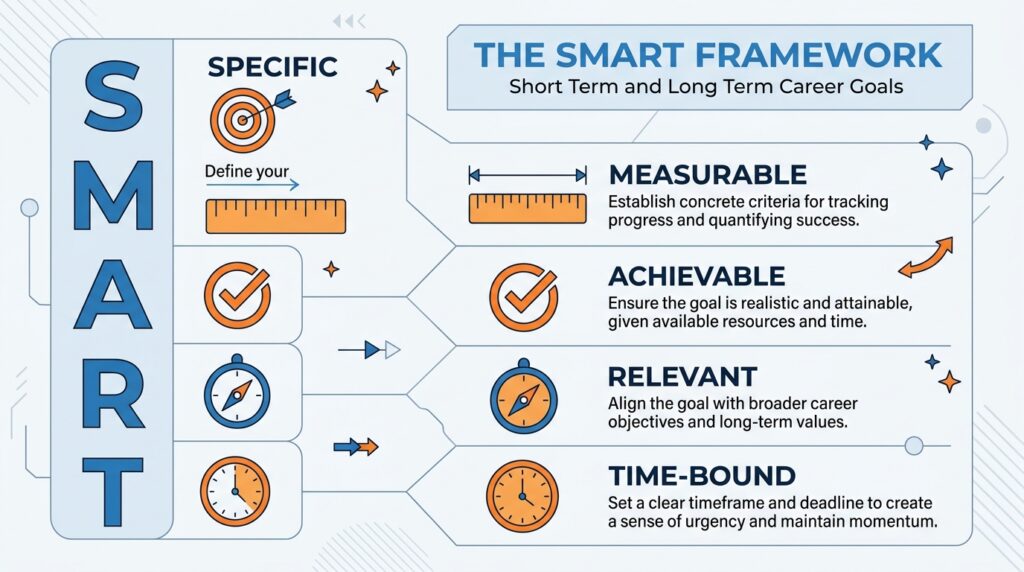
A goal without structure is just a wish. That’s why so many career coaches lean on the SMART goals framework, a method that has been used in workplaces and personal development plans for decades. SMART stands for Specific, Measurable, Achievable, Relevant, and Time-bound, and applying it to both short-term and long-term goals is one of the fastest ways to make sure they actually connect.
Specific
Vague goals like “get better at my job” don’t give you anything to act on. A specific version might be: “Complete an advanced Excel certification by the end of the quarter.”
Measurable
You need a way to know whether you’ve actually hit the goal. Numbers, deadlines, and clear outcomes work best. Instead of “network more,” try “attend two industry networking events per month.”
Achievable
The goal should stretch your ability without being unrealistic given your current time, resources, and skill level. Overly ambitious short-term goals tend to get abandoned within weeks.
Relevant
Every short-term goal should tie back to a long-term one. If it doesn’t move you toward your bigger career vision, it’s probably a distraction, even if it feels productive.
Time-bound
A deadline turns a goal into a commitment. Without one, it’s easy to keep pushing a task to “someday,” which usually means never.
| SMART Element | Short-Term Goal Example | How It Supports the Long-Term Goal |
|---|---|---|
| Specific | Finish a project management course | Builds the exact skill needed for a leadership role |
| Measurable | Complete 3 modules per week | Tracks steady progress toward certification |
| Achievable | Study 30 minutes on weekdays | Fits realistically into a full-time work schedule |
| Relevant | Course is directly tied to target promotion | Keeps effort focused, not scattered |
| Time-bound | Finish within 8 weeks | Creates urgency and a clear finish line |
Step-by-Step: How to Set Short-Term Goals That Support Long-Term Career Goals
Here’s a practical process you can follow this week, not someday.
Step 1: Define Your Long-Term Career Goal First
Start with the destination. Where do you want to be professionally in three, five, or ten years? Write it down in one or two sentences. It doesn’t need to be perfect yet.
Step 2: Work Backward Into Milestones
Break that long-term goal into two or three major milestones. If your goal is to become a senior data analyst, milestones might include gaining a specific certification, leading a small project, and building visibility with leadership.
Step 3: Turn Each Milestone Into Short-Term Goals
For each milestone, list the smaller, immediate actions that get you there. This is where the SMART system for career goals becomes useful, since it forces each action to be concrete and time-bound rather than vague.
Step 4: Prioritize Based on Impact
You likely can’t do everything at once. Ask which short-term goals will move the needle most on your long-term goal, and focus your energy there first.
Step 5: Set a Review Rhythm
Check in on your goals regularly. Weekly for short-term tasks, quarterly for the bigger milestones. Adjust as you learn more about yourself and your field.
Step 6: Celebrate Completed Short-Term Goals
This step gets skipped constantly, but it matters. Acknowledging progress, even briefly, keeps motivation alive over the months and years a long-term goal usually requires.
Real-Life Examples of Short-Term Goals Leading to Long-Term Career Wins
Seeing the connection in action often makes it click faster than theory alone.
| Long-Term Career Goal | Short-Term Goals That Support It | Typical Timeframe |
|---|---|---|
| Become a people manager | Volunteer to lead a small team project, take a communication skills course, ask for mentorship from a current manager | 6–12 months |
| Switch careers into UX design | Complete a design bootcamp, build a portfolio with 3 sample projects, apply for entry-level design roles | 6–18 months |
| Start a small business | Save a specific amount monthly, take a business fundamentals course, build a client list on the side | 1–3 years |
| Become a certified public accountant | Pass one exam section at a time, gain required work experience hours, join a study group | 1–2 years |
| Reach a senior engineering role | Master a new programming language, contribute to open-source projects, present at an internal tech talk | 1–3 years |
Notice a pattern here. Every long-term goal is supported by three to four short-term goals that are specific enough to start this month, not “eventually.”
Common Mistakes That Break the Link Between Short-Term and Long-Term Goals
Even motivated people sabotage their own progress without realizing it. Here are the patterns worth watching for.
Setting Short-Term Goals That Don’t Actually Connect to Anything
It’s easy to stay busy without making progress. Taking a random course because it sounded interesting, without asking whether it supports your bigger goal, is a common trap.
Skipping the Long-Term Goal Entirely
Some people jump straight into short-term tasks, chasing promotions or skills without ever defining where they’re actually headed. Without a destination, short-term effort tends to scatter in different directions instead of building toward something.
Making Long-Term Goals Too Vague
“Be successful” or “make more money” aren’t goals you can plan around. A long-term goal needs enough clarity that you can identify the milestones leading up to it.
Ignoring Progress Check-Ins
Goals set once and never revisited tend to drift out of relevance. Life changes, industries shift, and interests evolve. A goal that made sense two years ago might not fit anymore.
Giving Up After a Setback
Missing a deadline or failing a certification exam feels discouraging, but it’s rarely a sign to abandon the long-term goal. It’s usually a sign to adjust the short-term plan.
Expert Tips for Staying Consistent With Your Career Goals
Consistency, not intensity, is what actually gets people to their long-term goals. A few practical habits make a real difference.
- Write your goals down. Goals that exist only in your head are easy to forget or reshape in your memory. A written goal is easier to track and revisit.
- Attach a deadline to every short-term goal. Even a rough one. Deadlines create urgency, and urgency drives action.
- Pair goals with an accountability partner. A mentor, colleague, or friend who checks in with you regularly makes it noticeably harder to quietly abandon a goal.
- Review your progress on a fixed schedule. Weekly for short-term tasks, quarterly for long-term direction. Put it on your calendar like any other commitment.
- Keep a running list of completed goals. On tough days, looking back at what you’ve already accomplished is one of the fastest ways to rebuild motivation.
- Stay flexible with the path, not the destination. The route to a long-term goal will change. That’s normal. What matters is staying anchored to why the goal mattered in the first place.
Pros and Cons of Focusing Heavily on Short-Term Goals
Short-term goals are powerful, but leaning on them too heavily without a long-term anchor has real downsides. It helps to see both sides clearly.
Pros:
- Provides quick wins and steady motivation
- Easier to plan, measure, and adjust
- Reduces overwhelm by making progress feel manageable
- Builds real skills and experience along the way
- Gives you fast feedback on whether a direction is working
Cons:
- Can lead to busywork if goals aren’t tied to a bigger vision
- Risk of chasing short-term rewards (a quick promotion, a small raise) that don’t align with long-term satisfaction
- Easy to lose sight of the “why” behind daily tasks
- May cause frequent direction changes if long-term planning is skipped
- Can create a false sense of progress without real career growth
The takeaway isn’t to avoid short-term goals. It’s to make sure every one of them is chosen deliberately, with the long-term goal in mind.
Tools and Habits to Track Your Progress
Tracking progress doesn’t need to be complicated. A few simple systems tend to work better than complex ones people abandon after two weeks.
- A physical or digital planner where you list short-term goals with deadlines
- A simple spreadsheet tracking milestones, target dates, and completion status
- Calendar reminders for weekly and quarterly check-ins
- A journal to reflect on what’s working and what needs adjusting
- Regular conversations with a mentor or manager about your progress toward bigger goals
The specific tool matters far less than the habit of actually using it consistently.
FAQs
How can short term goals best lead towards accomplishing long term career goals?
They work best when each short-term goal is deliberately chosen as a stepping stone toward a specific long-term goal, broken into achievable, time-bound tasks, and reviewed regularly to make sure they’re still pointing in the right direction.
How many short-term goals should I set at once?
Most people manage best with two to four active short-term goals at a time. Setting too many at once often leads to spreading effort too thin and finishing none of them well.
What’s a realistic timeframe for a long-term career goal?
Long-term career goals typically span one to five years, though some, like reaching an executive-level role, may take longer. The right timeframe depends on your starting point and the goal’s complexity.
What should I do if my short-term goals aren’t leading anywhere?
Pause and check whether each short-term goal actually connects to your long-term goal. If it doesn’t, it’s likely disconnected busywork rather than meaningful progress, and it’s worth replacing with something more relevant.
Is it normal for long-term career goals to change over time?
Yes, completely normal. As you gain experience and complete short-term goals, you learn more about what you actually want. Adjusting a long-term goal based on that new information is a sign of good self-awareness, not failure.
Conclusion
The path from where you are now to the career you actually want isn’t built with one big decision. It’s built with dozens of small, deliberate short-term goals that each move you a little closer to the long-term vision you’re working toward. Start small. Pick one long-term goal, break it into a few short-term steps, and give yourself a deadline this week. That single decision is often the difference between a goal that stays a dream and one that becomes a plan.
If this breakdown helped clarify your next move, take five minutes today to write down one long-term career goal and the first short-term step you’ll take toward it. Small, consistent action really is the fastest route to long-term career success.
Disclaimer: This article is for informational purposes only and does not constitute professional career, financial, or legal advice. Please consult a qualified career counselor or professional advisor for guidance specific to your personal situation.