
It’s 11 p.m., the paper is due tomorrow, and you’re 400 words short. Every student has been there. The instinct is to widen the margins, bump the font up half a point, or start every sentence with “furthermore.” None of that actually helps, and most professors have seen those tricks a thousand times.
If you’re searching for how to make an essay longer, the real answer isn’t about tricking a word counter. It’s about finding the places where your argument is thinner than it should be and filling those gaps with actual content: more evidence, sharper analysis, and a few more angles on the same idea. Below is a practical breakdown of what works, what doesn’t, and how to tell the difference.
Why Your Essay Feels Short in the First Place
Before adding a single word, it helps to know why the draft came up short. Usually it’s one of three things: the thesis statement is too narrow to support a full paper, the evidence is thin, or the analysis stops right when it gets interesting.
A thesis that’s too broad or too vague creates the opposite problem, rambling without direction, but a thesis that’s too narrow gives you nothing left to say by paragraph three. If your outline only has two supporting points where the assignment calls for four, that’s not a length problem. That’s a planning problem, and it’s worth fixing at the source.
Add More Evidence, Not More Words
The fastest legitimate way to extend an essay is to support claims you’ve already made instead of just stating them. If you wrote “social media affects teen mental health,” that’s one sentence. Backing it up with a specific study, a statistic, or a real example can turn it into a full paragraph.
A few ways to do this without sounding like a list of random facts:
- Pull in a second source that either supports or complicates your first one
- Add a specific example, a case, a data point, an anecdote, that makes the abstract claim concrete
- Quote a short line from a source and then spend two or three sentences explaining what it means for your argument
This is also where citation habits matter. If you’re using outside sources, keep your formatting consistent, whether that’s MLA or another required style, so the added material actually reads as part of the paper rather than a patch stitched on at the end.
Push Your Analysis One Layer Deeper
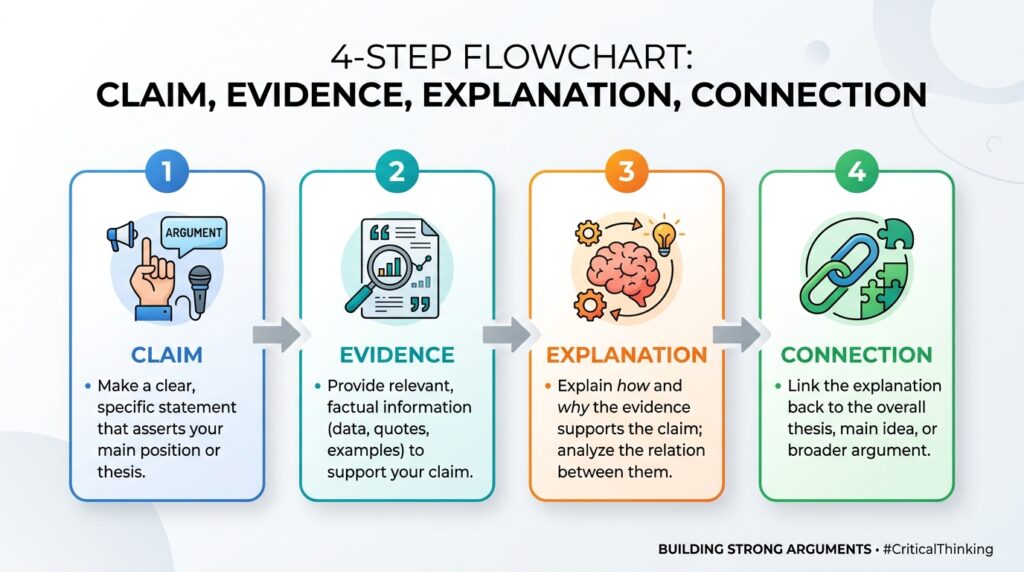
Most student essays state a claim, offer one piece of evidence, and move on. That’s where a lot of length gets left on the table. After you present evidence, ask “so what?” Why does this fact matter for your argument? What would someone who disagrees say, and how would you respond?
This “so what” step often doubles the size of a paragraph naturally, because you’re not repeating yourself, you’re extending the thought. It’s also the part of an essay professors tend to weight most heavily, since it shows you can actually reason through a problem instead of just reporting facts.
A simple structure to try in each body paragraph:
- State the claim
- Give the evidence
- Explain what the evidence means
- Connect it back to the thesis
If you’re only doing steps one and two right now, adding three and four is often the single biggest length gain available to you, and it improves the grade too.
Address the Counterargument
Skipping the other side of an issue is one of the most common reasons argumentative essays run short. A paragraph, or even a full section, that fairly presents an opposing view and then responds to it adds real intellectual weight and real word count at the same time.
This works especially well for argumentative essays, where the structure practically expects you to acknowledge pushback before reinforcing your own position. Even in a more analytical or expository paper, a short “some might argue” paragraph can round out an otherwise one-sided draft.
Try this pattern:
- Introduce the counterargument fairly, in your own words, without exaggerating it
- Explain the reasoning behind it
- Respond with your own evidence or logic showing why your position still holds, or where it needs to be adjusted
Strengthen Your Introduction and Conclusion
Introductions and conclusions get rushed more than any other part of an essay, which means they’re often the easiest place to responsibly add length. An introduction that jumps straight to the thesis in one sentence is missing context the reader needs: why does this topic matter, what’s the background, what’s at stake?
A stronger introduction usually has:
- A hook or context-setting opening line
- Background information the reader needs before the thesis makes sense
- The thesis statement itself, placed at or near the end of the paragraph
The conclusion deserves the same treatment. Instead of a one-line restatement of the thesis, use it to explain the broader implications of your argument. What does this mean beyond the essay itself? Why should the reader care now that they’ve finished reading?
Use Transitions to Connect, Not Just Extend
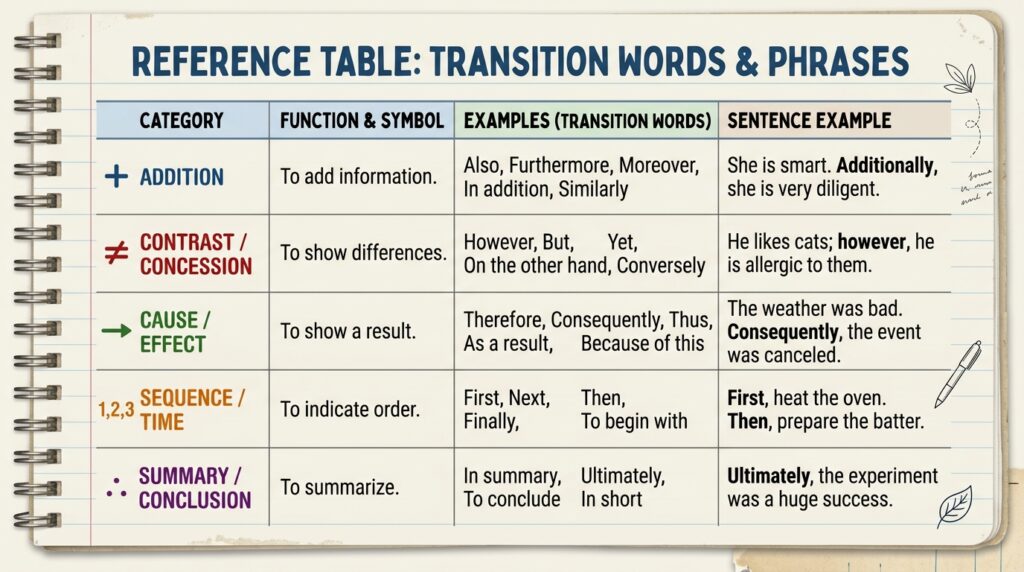
Transitions get a bad reputation because they’re sometimes used as filler, “in addition,” “moreover,” “furthermore,” stacked at the start of sentences that don’t actually connect to anything. Used properly, though, transitions do real work: they show the reader how one idea builds on the last one, which often reveals a missing logical step you hadn’t written yet.
If you try to write a transition sentence between two paragraphs and it feels impossible, that’s useful information. It usually means there’s a gap in your reasoning, and filling that gap with an actual explanatory sentence or two adds both clarity and length.
A short table of natural-sounding transition types:
| Purpose | Example phrases |
|---|---|
| Adding a point | also, in addition, another factor |
| Showing contrast | however, on the other hand, still |
| Showing cause and effect | as a result, because of this, this leads to |
| Giving an example | for instance, one case is, this is evident in |
Break Down Compound Ideas
Sometimes a single dense sentence is actually two or three ideas crammed together. Splitting a compound sentence into separate sentences, each fully explained, is not padding. It’s clarity, and it naturally adds length because each idea now gets its own space to breathe.
For example, a sentence like “Climate change affects agriculture and coastal cities and this creates economic problems” is really three separate claims. Unpacked properly, each one can become its own sentence or even its own short paragraph, with a bit of explanation for why it matters.
This technique works particularly well in papers where you’re already citing a lot of information but summarizing it too quickly.
Add a New Supporting Point, Not a Repeated One
If your essay asks for five reasons and you only have three, don’t stretch those three thinner. Brainstorm a fourth and fifth point instead. This is often faster than it sounds: go back to your research notes, your class readings, or even a quick, targeted search on your topic, and look for an angle you didn’t use the first time.
A quick gut check before adding a new point: does it genuinely support the thesis, or is it a stretch to hit a number? Readers, and professors, can tell the difference between a paper with five well-argued points and a paper with three good points and two weak ones added at the end.
What to Avoid When Trying to Add Length
Not every length-adding trick holds up under a closer read. A few habits are worth skipping entirely:
Pros of legitimate expansion techniques:
- Improves the actual quality and grade of the essay
- Makes the argument more persuasive and complete
- Holds up under a professor’s or editor’s review
Cons of artificial padding techniques:
- Font and margin tricks are easy to spot and can look dishonest
- Repeating the same point in different words weakens the paper
- Overly long, vague sentences hurt readability and clarity
- Adding unrelated facts breaks the essay’s focus
Things to avoid specifically:
- Changing font size or margins to fake length
- Repeating the same sentence with slightly different wording
- Adding a paragraph of information that doesn’t connect to the thesis
- Overusing synonyms through a thesaurus in a way that sounds unnatural
- Writing long, run-on sentences just to raise the word count
A Quick Editing Pass to Find Natural Length
Once you’ve drafted more content, go back through with these questions for each paragraph:
- Does every claim have at least one piece of support?
- Have I explained why the evidence matters, not just stated it?
- Is there an opposing view I haven’t addressed?
- Could this paragraph be split into two clearer ones?
- Does the introduction give enough context, or does it jump too fast?
Going paragraph by paragraph this way usually adds several hundred words on its own, and it’s the same process professional editors use, just applied to a shorter document.
FAQs
How can I make my essay longer without adding fluff?
Focus on supporting the claims you’ve already made with more evidence and explanation, rather than adding new sentences that just restate the same idea. Expanding your analysis after each piece of evidence is usually the fastest way to add real content.
Is it okay to add a counterargument just to increase word count?
Yes, as long as you represent the opposing view fairly and respond to it with your own reasoning. A well-handled counterargument section adds both length and depth, and many argumentative essay formats expect one anyway.
Will changing the font or margins get flagged by a professor?
It can. Formatting tricks are usually easy to notice, especially in digital submissions, and they don’t add any actual content. It’s safer and more effective to expand the substance of the essay instead.
How many extra sentences should each paragraph have to fix a short essay?
There’s no fixed number, but a good target is making sure each paragraph has a claim, evidence, an explanation of that evidence, and a connection back to the thesis. If a paragraph is missing one of those parts, adding it usually brings the paragraph to a reasonable length.
What’s the difference between padding an essay and expanding it properly?
Padding adds words without adding meaning, repeated phrasing, unrelated facts, formatting tricks. Expanding adds meaning along with the words, more evidence, deeper analysis, addressed counterarguments, so the essay actually gets stronger, not just longer.
Final Thought
Length problems are almost always depth problems in disguise. Once you start looking for the thin spots, an underdeveloped claim, a skipped counterargument, an introduction that rushes past the context, the extra words tend to show up on their own, and the essay ends up better for it, not just longer.