
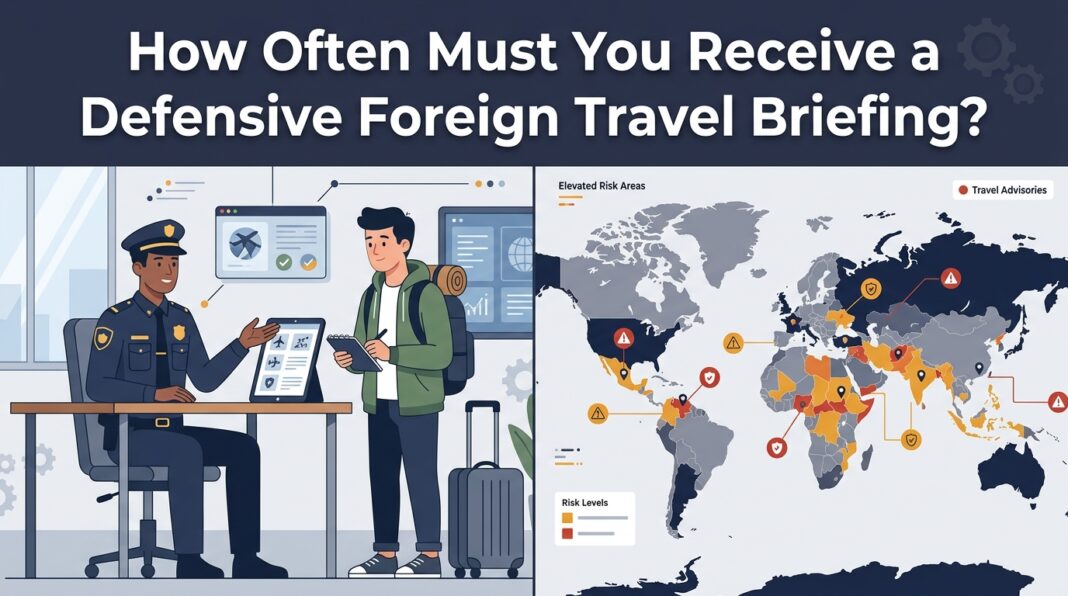
If you hold a security clearance, work for a defense contractor, or travel overseas for a government agency, someone has probably told you to “get briefed before you go.” But the actual rule behind that instruction is more specific than most people realize, and it trips up a lot of first-time travelers.
So, how often must you receive a defensive foreign travel briefing? The short answer: before every trip abroad, and at least once every 12 months, even if you aren’t traveling. That two-part requirement is the standard used across the defensive security briefing framework that most federal agencies and cleared contractors follow.
That single sentence answers the test-question version of this topic. But the real value is in understanding why both timeframes exist, who’s actually required to comply, and what happens if you skip it. That’s what the rest of this covers.
What a Defensive Foreign Travel Briefing Actually Is
A defensive foreign travel briefing isn’t a lecture on customs etiquette. It’s a security-focused session designed to prepare travelers, particularly those with a clearance or access to sensitive information, for the specific risks tied to traveling outside the country.
These briefings typically cover:
- How foreign intelligence services target travelers, including elicitation and surveillance tactics
- What to do if you’re approached, questioned, or think you’re being watched
- Rules on carrying and discussing classified or proprietary information abroad
- Emergency contacts and reporting procedures if something goes wrong
- Destination-specific risks tied to the country or region you’re visiting
The goal isn’t to scare anyone off traveling. It’s to make sure people understand that, as the official foreign travel briefing resources put it, cleared personnel are considered higher-value targets the moment they cross a border.
How Often Must You Receive a Defensive Foreign Travel Briefing? The Two-Part Rule
This is the part most training modules and quizzes are really asking about, and it’s worth breaking down plainly.
Requirement 1: Before Every Trip
Any time you’re heading outside the country, whether for official duty or personal vacation, you’re expected to get a briefing beforehand. This isn’t a one-and-done annual box to check. Each trip carries its own risk profile depending on the destination, so a pre-travel session is meant to be destination-specific whenever possible.
Requirement 2: At Least Once a Year
Even during a stretch where you’re not traveling, most policies still require an annual refresher. Threat landscapes shift fast. New geopolitical tensions, updated intelligence collection methods, and emerging cyber threats can all change within months, so an annual touchpoint keeps that awareness current.
Together, these two requirements form the standard most people are quizzing on: prior to travel, and at least annually. Any answer suggesting “every two years” or “never” is incorrect and doesn’t reflect actual policy.
| Requirement | When It Applies | Why It Matters |
|---|---|---|
| Pre-travel briefing | Before each foreign trip | Covers destination-specific threats |
| Annual briefing | Every 12 months, regardless of travel | Keeps general awareness current |
| Post-travel debrief | After returning | Flags suspicious contacts or incidents |
Who Is Actually Required to Get One
Not everyone needs this briefing before booking a flight. It generally applies to:
- Government employees and military personnel with a security clearance
- Defense contractors and cleared industry employees
- Individuals holding a sensitive position, as defined under federal reporting policy
- Personnel with access to classified or controlled information
If none of that applies to you, you’re not bound by these rules, though the underlying safety practices, like limiting what you share about your itinerary or being cautious with strangers who ask too many questions, are useful for any international traveler.
For anyone unsure whether they’re covered, the SEAD 3 reporting requirements document lays out exactly who qualifies as a “covered individual” and what’s expected of them.
Why the Rule Exists in the First Place
It’s easy to treat this as bureaucratic box-checking, but there’s a real reason behind it. People with access to classified or sensitive information are attractive targets the moment they leave familiar territory. Foreign intelligence services don’t need to hack a network if they can simply strike up a conversation with the right person at a conference bar.
Common tactics travelers are warned about include:
- Elicitation — casual, low-pressure conversation designed to extract information without the target realizing it
- Surveillance — physical or electronic monitoring of movements and communications
- Staged encounters — seemingly random meetings with someone who shares your professional interests
- Border questioning — extended or unusual interviews at checkpoints designed to gather personal or professional details
None of these tactics are new, but they evolve constantly, which is exactly why a stale briefing from three years ago doesn’t cut it.
What Happens If You Skip the Briefing
Skipping a required briefing isn’t just a paperwork issue. Depending on your role, it can lead to:
- Denied or delayed approval for official travel
- Findings during a security clearance review or reinvestigation
- Increased personal risk if you’re unaware of destination-specific threats
- Compliance flags for your organization’s security office
Security offices generally track this through internal training records, so it’s rarely something that quietly slips through the cracks, especially for personnel with active clearances.
How to Actually Get Briefed
If you’re required to complete one, the process is usually straightforward:
- Contact your security office. Your Facility Security Officer (FSO) or agency security liaison typically coordinates these sessions and keeps the records.
- Use available training portals. Agencies often rely on standardized modules like those found through the Center for Development of Security Excellence for both initial and refresher training.
- Report your travel itinerary. Depending on your position, you may need to submit travel details in advance, sometimes through a system tracked under SEAD 3 unofficial foreign travel reporting.
- Complete a post-travel debrief. Many organizations expect a short debrief after you return, especially if anything unusual happened during the trip.
For general destination safety information that applies to any traveler, checking current country-specific travel advisories before booking is a smart habit regardless of clearance status.
Pros and Cons of the Annual-Plus-Pre-Travel Model
No policy is without trade-offs. Here’s a fair look at how this system holds up in practice.
Strengths:
- Keeps travelers current on fast-changing threat information
- Adds a destination-specific layer that a single annual session can’t provide
- Creates a documented compliance trail for security offices
- Encourages a habit of caution rather than a one-time checkbox mentality
Limitations:
- Frequent travelers may find back-to-back briefings repetitive
- Briefing quality can vary significantly between organizations
- Smaller agencies or contractors sometimes lack dedicated training staff to deliver timely sessions
- Records management across multiple systems can create administrative friction
Even with those limitations, the two-part structure remains the standard because the alternative, relying on outdated information, carries far more risk than a little repetition.
Expert Tip: Treat the Annual Briefing as a Baseline, Not the Whole Picture
Security professionals generally advise against treating the once-a-year session as sufficient on its own. If you have a trip coming up to a region with elevated risk, it’s worth requesting a destination-specific add-on even if your annual briefing was completed recently. Threat conditions in a given country can shift within weeks, and a briefing from January won’t reflect a situation that changed in June.
It’s also worth keeping a personal record of when you were briefed and for which trip. Security offices track this, but having your own documentation avoids confusion if travel plans change last minute.
Frequently Asked Questions
How often must you receive a defensive foreign travel briefing if you don’t travel every year?
Even without travel plans, most policies still require an annual refresher briefing. It keeps your general threat awareness current in case travel comes up unexpectedly.
Does a defensive foreign travel briefing expire?
There’s no fixed “expiration date” stamped on the briefing itself, but it’s generally considered current for about a year, or until your next foreign trip, whichever comes first.
Who is exempt from defensive foreign travel briefing requirements?
Individuals without a security clearance, sensitive position, or access to classified information typically fall outside these formal requirements, though the safety practices still apply informally to any international traveler.
What’s the difference between a briefing and a debrief?
A briefing happens before travel and focuses on risk awareness for the destination. A debrief happens afterward and is used to report anything unusual, like unexpected contacts or suspicious activity, that occurred during the trip.
Can you complete a defensive foreign travel briefing online?
Yes, many organizations use standardized online training modules for the annual refresher, though destination-specific pre-travel briefings are sometimes still handled in person through a security office.
Final Thoughts
The rule itself isn’t complicated once it’s laid out clearly: brief before you go, and refresh at least once a year. What trips people up is treating it as a formality instead of a real safeguard. Threats tied to foreign travel evolve constantly, and a briefing that’s months out of date can leave gaps that matter.
If you’re due for one, the fastest path is your organization’s security office or an approved training portal. It takes far less time than dealing with the fallout of skipping it.
This content is for informational purposes only and does not constitute official security, legal, or travel guidance. Requirements can vary by agency, organization, and clearance level. Always confirm current policy with your organization’s security office or the relevant governing directive.