

Every factory floor runs on a simple truth: materials cost money, and some materials cost a lot more than others. Steel, rare earth metals, clean water, and fossil fuels don’t just get pulled out of the ground for free. They get harder to find, more expensive to buy, and more unpredictable to plan around every year.
So how would a manufacturer benefit by using fewer scarce resources? In short, a company that trims its use of limited materials tends to spend less, waste less, and worry less about supply chain shocks. It also tends to build a more resilient business that can adapt when prices spike or suppliers run dry. This isn’t a trendy talking point reserved for large corporations with sustainability departments. It’s a practical survival strategy that small workshops and massive factories both rely on.
This guide breaks down exactly what “scarce resources” means in a manufacturing context, why using fewer of them pays off financially and operationally, and how real companies are doing it today. No jargon-heavy economics lecture here, just a clear, beginner-friendly walkthrough of one of the most useful ideas in modern production.
What Does “Scarce Resources” Mean in Manufacturing?
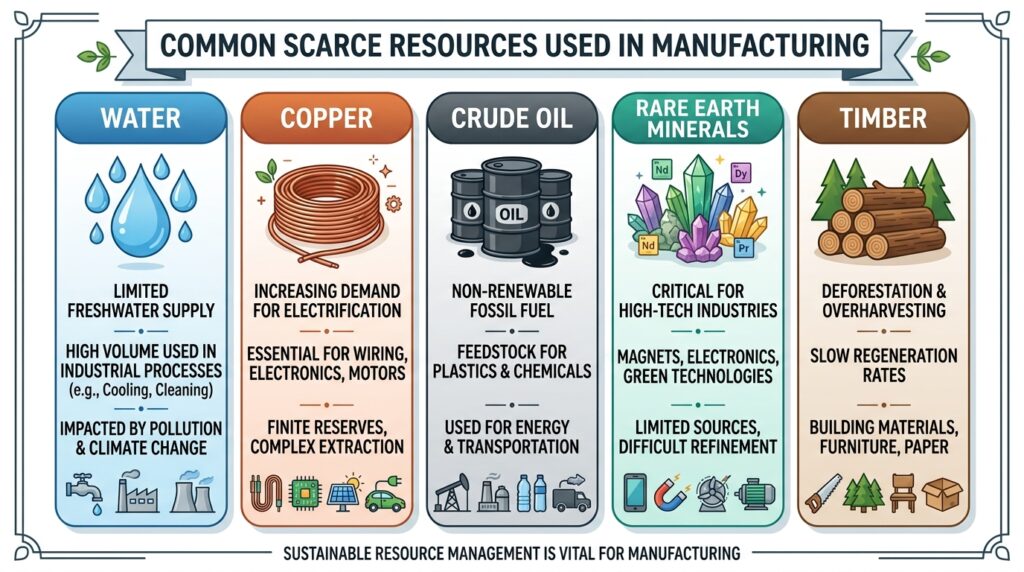
In basic economic terms, scarcity describes a situation where the supply of something is limited compared to how much people want or need it. It’s a foundational idea in economics because almost nothing on earth is available in unlimited quantities. Time, land, labor, and raw materials all fall under this umbrella.
For a manufacturer, scarce resources usually mean the physical inputs that go directly into making a product. That includes raw materials like copper, aluminum, lithium, and timber, along with energy sources such as natural gas and electricity. It can also include water, which is becoming a serious constraint in several manufacturing regions, and even skilled labor, which has grown harder to source in certain industries.
The key point is that scarcity creates cost pressure. When something is limited, its price tends to rise as demand grows or supply shrinks. A detailed breakdown of scarcity in a business context explains that companies are constantly forced to make tradeoffs about how they allocate these limited inputs, because there simply isn’t enough to go around without careful planning.
Types of Scarce Resources Manufacturers Rely On
Image Prompt: A simple categorized chart showing four icons: raw materials (ore and metal), energy (lightning bolt and gas pump), water (droplet), and skilled labor (worker silhouette), each labeled with a short description. Style: minimal icon-based infographic. ALT Text: Categories of scarce resources manufacturers depend on including raw materials, energy, water, and labor
Manufacturers typically deal with four broad categories of scarce inputs:
- Raw materials — metals, minerals, plastics derived from petroleum, and specialty chemicals that fluctuate in price based on global mining and extraction output.
- Energy — electricity, natural gas, and fuel used to power machinery, run assembly lines, and transport goods.
- Water — used in cooling systems, cleaning processes, and as an ingredient in certain products like food, beverages, and pharmaceuticals.
- Skilled labor and specialized components — trained technicians, engineers, and semiconductor chips or precision parts that take years to source reliably.
Each of these resources behaves a little differently, but they share one thing in common. When a manufacturer uses less of them per unit produced, the savings show up almost immediately on the balance sheet.
How Would a Manufacturer Benefit by Using Fewer Scarce Resources?
This is the core question, so let’s answer it directly before going deeper. A manufacturer that reduces its reliance on scarce resources typically sees benefits across seven major areas: cost, supply chain stability, profit margins, brand reputation, regulatory standing, innovation capacity, and long-term resilience. Each one connects to the others, which is why resource efficiency has become such a central theme in modern operations strategy.
Lower Production Costs
The most immediate benefit is financial. Raw materials, energy, and water all carry a direct cost per unit of output. When a manufacturer figures out how to produce the same product using less material or less energy, that savings drops straight to the bottom line.
Think about a furniture maker that redesigns a chair frame to use 15% less lumber without losing structural strength. Multiply that savings across thousands of units, and it becomes a meaningful reduction in annual material spend. This kind of efficiency doesn’t require cutting corners on quality. It requires smarter design and process planning.
Cost savings from efficient resource use aren’t a minor side benefit either. The U.S. Environmental Protection Agency’s sustainable manufacturing guidance notes that companies pursuing these practices are realizing substantial financial and environmental returns, largely because reducing waste and optimizing energy use directly lowers operating expenses.
Reduced Dependence on Volatile Supply Chains
Scarce materials tend to have unstable prices. When global demand spikes, or a mine shuts down, or a shipping route gets disrupted, the cost of a key input can jump overnight. A manufacturer that has already reduced its dependence on that material is far less exposed to that shock.
This matters more today than it did a decade ago. Supply chains for things like semiconductors, rare earth metals, and certain plastics have shown just how fragile global sourcing networks can be. Companies that built in flexibility, by using less of a scarce input or by designing products that can accept substitute materials, weathered those disruptions with far less pain than competitors locked into a single source.
Improved Profit Margins
Lower costs combined with more predictable supply naturally push profit margins upward. A manufacturer isn’t just saving money once. It’s protecting its margin from future price increases, which compounds over time.
Here’s a simplified example of how this plays out across a production run:
| Factor | High Resource Use | Reduced Resource Use |
|---|---|---|
| Material cost per unit | $12.50 | $9.80 |
| Waste disposal cost | $1.20 | $0.40 |
| Energy cost per unit | $3.75 | $2.60 |
| Total cost per unit | $17.45 | $12.80 |
| Estimated margin improvement | Baseline | +26.6% |
These numbers are illustrative rather than drawn from a single real company, but they reflect the general pattern seen across manufacturing case studies where waste reduction and material optimization were prioritized.
Stronger Brand Reputation and Customer Trust
Consumers and business buyers increasingly pay attention to how products are made. A manufacturer that visibly reduces its resource footprint, whether through recycled materials, lower emissions, or transparent sourcing, tends to build stronger trust with customers who care about those issues.
This isn’t just goodwill either. Business-to-business buyers, especially large retailers and government contractors, often require suppliers to document their resource efficiency and environmental practices as part of procurement standards. Manufacturers that already operate lean have a competitive edge in winning those contracts.
Better Regulatory Compliance
Environmental regulations around waste, emissions, and water use continue to tighten across many industries. A manufacturer that has already reduced its use of scarce resources typically finds it easier to stay ahead of new compliance requirements rather than scrambling to retrofit operations after a rule change.
The EPA’s sustainable materials management framework points out that examining a product’s full lifecycle, from raw material extraction through disposal, helps companies spot opportunities to reduce environmental impact and cut costs at the same time. That dual benefit is exactly why regulatory readiness and resource efficiency tend to go hand in hand.
Increased Innovation and Competitive Advantage
Constraints often drive creativity. When a manufacturer sets a goal to use less of a scarce material, engineers and designers are forced to rethink processes, packaging, and product architecture. That kind of problem-solving frequently uncovers innovations that improve the product itself, not just its resource footprint.
Automakers redesigning components to use less rare-earth metal in electric motors, for example, have discovered alternative magnet designs that perform just as well while reducing dependence on hard-to-source materials. These innovations often become a genuine competitive advantage, not just a cost-saving measure.
Long-Term Business Resilience
Put all of this together, and the bigger picture becomes clear. A manufacturer using fewer scarce resources is building a business that can absorb shocks, adapt to new regulations, and respond to shifting consumer expectations without a full operational overhaul. That resilience is arguably the most valuable long-term benefit, even though it’s harder to measure on a quarterly earnings report than cost savings.
The Economics Behind Scarcity and Manufacturing Efficiency
Economics 101 teaches a simple relationship. When supply is limited and demand stays steady or grows, prices rise. Manufacturers sit right in the middle of this dynamic because they are constantly buying inputs whose supply they don’t control.
This is why efficiency matters so much. A business can’t control the global price of copper or lithium, but it can control how much of that material it needs to produce one unit of output. Reducing that need is one of the few resource-related levers a manufacturer can actually pull.
There’s also a broader economic argument at play. Economists have long pointed out that scarcity forces tradeoffs, meaning every unit of a scarce material used in one product is a unit that can’t be used elsewhere. Manufacturers who use resources efficiently aren’t just protecting their own margins. They’re participating in a system where efficient use benefits the wider market by easing demand pressure on already-limited supplies.
This concept connects closely to the idea of a circular economy, an economic model built around keeping materials in use for as long as possible rather than extracting new resources and discarding them after a single use. Manufacturers who adopt circular thinking often find that reducing scarce resource consumption and increasing profitability go hand in hand rather than working against each other.
Real-World Examples of Manufacturers Reducing Scarce Resource Use
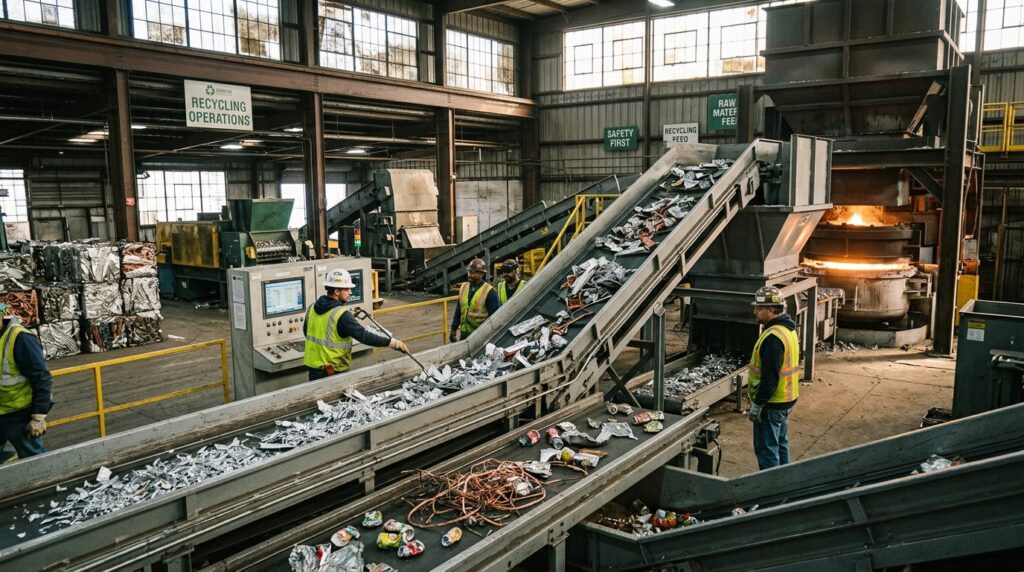
Real companies across different industries have already put resource efficiency into practice, often with measurable results.
Automotive manufacturers have shifted toward lightweight materials and modular part designs that use less raw steel and aluminum per vehicle while maintaining safety standards. Electronics manufacturers have redesigned circuit boards to reduce the amount of rare earth metals required, partly in response to supply disruptions from limited global mining sources.
Food and beverage producers have invested heavily in water recycling systems within their plants, since water scarcity has become a genuine operational risk in several manufacturing regions. Packaging companies have moved toward recycled cardboard and reduced plastic content, cutting both material costs and disposal fees.
None of these shifts happened purely out of environmental goodwill. They happened because reducing scarce resource use made financial sense once companies did the math on long-term savings versus short-term retooling costs.
Practical Strategies to Reduce Scarce Resource Use in Manufacturing
Understanding the benefits is one thing. Actually reducing scarce resource use requires specific operational changes. Here are the strategies manufacturers commonly rely on.
Lean Manufacturing Principles
Lean manufacturing is a system built around creating more value for customers while using fewer resources to do it. Originally developed from the Toyota Production System, lean thinking focuses on eliminating waste at every stage of production, whether that waste shows up as excess material, wasted motion, or unnecessary waiting time.
Applying lean principles often starts with mapping out the entire production process to identify where material, time, or energy is being wasted. Small changes, like adjusting cutting patterns to reduce scrap or reorganizing workstations to cut down on unnecessary material handling, can add up to significant resource savings over a year.
Circular Economy Practices
Rather than treating manufacturing as a straight line from raw material to finished product to landfill, circular economy practices aim to keep materials moving in a loop. This might mean designing products so components can be disassembled and reused, or setting up take-back programs where customers return old products for material recovery.
Manufacturers adopting circular practices often find that scrap material once treated as waste can become a valuable input for a different production run, cutting the need to purchase new scarce raw materials.
Material Substitution
Sometimes the most effective way to use fewer scarce resources is to swap them for more abundant alternatives. This could mean replacing a rare metal with a more common alloy that performs a similar function, or switching from virgin plastic to recycled plastic without sacrificing product durability.
Material substitution requires careful testing to ensure product quality and safety standards are maintained, but the long-term savings and supply chain stability it offers often justify the upfront research and development cost.
Energy Efficiency Upgrades
Energy is one of the most direct scarce resources a manufacturer consumes daily. Upgrading to more efficient motors, installing better insulation, switching to LED lighting, and investing in smart energy monitoring systems all reduce the amount of energy needed per unit produced.
These upgrades often pay for themselves within a few years through reduced utility bills, and many regions offer incentive programs that offset the initial investment cost.
Waste Reduction and Recycling
Reducing waste isn’t only about the environment. Every scrap of material that ends up in a landfill represents money spent on a resource that was never turned into a sellable product. Setting up systems to capture, sort, and either reuse or sell scrap material can turn what was once a cost center into a modest revenue stream.
Pros and Cons of Reducing Scarce Resource Consumption
Resource efficiency isn’t a magic fix, and it’s worth understanding both sides before committing significant capital to a transition.
| Pros | Cons |
|---|---|
| Lower long-term material and energy costs | Upfront investment in new equipment or processes |
| Reduced exposure to price volatility | Employee retraining may be required |
| Stronger compliance with environmental regulations | Some material substitutions require lengthy testing |
| Improved brand reputation with customers and partners | Short-term productivity dip during transition periods |
| Greater supply chain resilience | Return on investment can take one to three years |
| Opportunities for product innovation | Not every process has an easy efficiency alternative |
The general pattern across most manufacturing case studies is that the upfront costs are temporary while the savings and stability benefits are ongoing. Still, every company needs to evaluate its own specific processes before assuming the payoff will match the general trend.
Expert Tips for Manufacturers Looking to Reduce Resource Use
- Start with a resource audit. Before changing anything, measure exactly how much of each scarce resource your current process consumes per unit. You can’t improve what you haven’t measured.
- Prioritize the highest-cost resource first. Focus initial efforts on whichever material or energy source represents the largest share of your production cost. That’s where efficiency gains will have the biggest financial impact.
- Involve floor-level employees early. Workers who run the machines every day often spot waste and inefficiency long before management notices it in the numbers.
- Test substitutions on a small batch first. Never roll out a new material or process across your entire production line without piloting it on a limited run to catch quality issues early.
- Track savings over time, not just once. Resource efficiency compounds. A small percentage reduction per unit adds up significantly across thousands of units produced annually.
- Stay aware of regulatory trends. Getting ahead of environmental compliance requirements is almost always cheaper than reacting to them after a deadline.
Common Mistakes Manufacturers Make When Trying to Cut Resource Use
- Cutting material use without testing product quality. Reducing material thickness or substituting a cheaper input without proper testing can lead to product failures and costly recalls.
- Ignoring the full lifecycle cost. Some efficiency changes save money in production but increase costs elsewhere, such as higher maintenance needs from a lower-quality substitute material.
- Underestimating employee training needs. New equipment or processes only deliver savings if workers know how to use them correctly.
- Treating efficiency as a one-time project. Resource use tends to creep back up over time without ongoing monitoring and accountability.
- Chasing every trend at once. Trying to implement lean manufacturing, circular economy practices, and material substitution simultaneously often overwhelms teams and leads to poor execution across the board.
Frequently Asked Questions
How would a manufacturer benefit by using fewer scarce resources?
A manufacturer benefits primarily through lower production costs, reduced exposure to supply chain disruptions, and improved profit margins. Using fewer scarce resources also strengthens regulatory compliance, builds customer trust, and often sparks product innovation that wouldn’t have happened otherwise.
What are examples of scarce resources in manufacturing?
Common examples include metals like copper, aluminum, and rare earth elements, along with energy sources such as natural gas and electricity, water used in production processes, and specialized components like semiconductor chips that face limited global supply.
Does reducing resource use always save money?
In most cases, yes, though the savings often take time to materialize. Some efficiency upgrades require an upfront investment in new equipment or process redesign, which typically pays off within one to three years through lower ongoing material and energy costs.
How is lean manufacturing related to resource scarcity?
Lean manufacturing is built around minimizing waste at every stage of production, which directly reduces the amount of scarce material, energy, and time consumed per unit produced. It’s one of the most widely used frameworks for achieving resource efficiency in factories.
Can small manufacturers benefit from resource efficiency too, or is it only for large companies?
Small manufacturers often benefit just as much, if not more, since they typically have tighter margins and less ability to absorb sudden price spikes in raw materials. Simple changes like reducing scrap waste or switching to more efficient equipment can make a meaningful difference even at a small operational scale.
Conclusion
So, how would a manufacturer benefit by using fewer scarce resources? The answer touches nearly every part of the business, from lower costs and steadier supply chains to stronger compliance, better brand reputation, and long-term resilience against market shocks. None of this requires a massive overnight transformation. It starts with understanding where scarce resources are being used inefficiently and making targeted, measurable changes from there.
Whether you’re running a small workshop or overseeing a large production facility, the same principle applies. Efficient use of scarce resources isn’t just good for the planet. It’s good business.
If you’re evaluating where your own operation stands, start with a simple resource audit this month. Identify your highest-cost material or energy input, and look for one realistic change you can pilot within the next quarter. Small, measured steps toward efficiency tend to build momentum faster than waiting for a perfect, large-scale plan.
This article is for general informational purposes only and does not constitute financial, legal, engineering, or business consulting advice. Always consult a qualified professional before making decisions related to your manufacturing operations, supply chain, or resource management strategy.