
A calendar invite says “business casual” and suddenly the closet feels like a puzzle. Slacks, yes. Sneakers, maybe. And somewhere in the middle of that pile sits the humble polo shirt, wondering if it even gets an invitation.
Here’s the short answer: is a polo business casual? Yes, in most offices a well-fitted polo shirt counts as business casual, especially when it’s made from a structured fabric like pique cotton and paired with tailored bottoms. But the full answer depends on fit, fabric, color, and what you pair it with, which is exactly what this guide walks through.
Business casual itself is one of the most ambiguously defined dress codes in modern offices, which is part of why a single garment like the polo can spark so much debate. So instead of guessing, let’s break down what actually separates an office-ready polo from one that belongs strictly at the golf course.
What “Business Casual” Actually Means in Practice
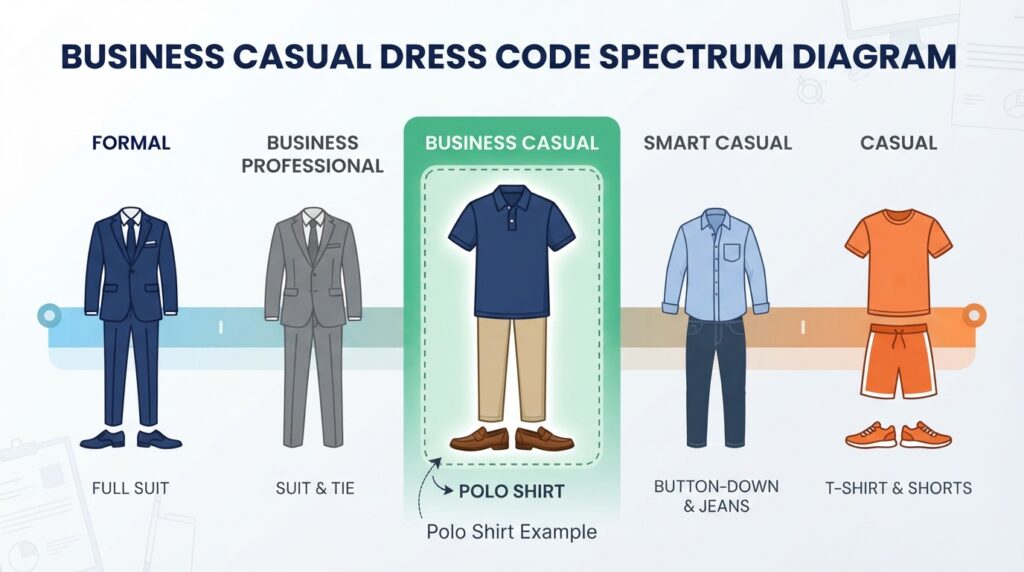
Before figuring out where a polo fits, it helps to understand the dress code it’s trying to fit into. Business casual isn’t a single outfit formula. It’s a moving target that shifts depending on your industry, your company culture, and even your role.
Generally, business casual sits between formal business wear (suits, ties, blazers) and everyday casual clothes (t-shirts, sneakers, distressed denim). It’s meant to look put together without requiring a full suit. According to career resources that cover workplace dress codes, business casual attire typically includes trousers, skirts, button-downs, sweaters, and yes, polo shirts, as long as they’re styled with intention.
A few traits define the category no matter where you work:
- Clean, wrinkle-free clothing
- Fitted, not baggy or overly tight
- Neutral or muted color palettes as a base
- Closed-toe shoes in most settings
- No visible logos, slogans, or graphic prints
Because there’s no universal rulebook, the safest approach is to treat business casual as a spectrum rather than a checklist. Some offices lean closer to business formal, others lean closer to smart casual, and your polo shirt needs to adjust accordingly.
The Polo Shirt’s Backstory Explains Why It Works for the Office
It’s easy to assume the polo shirt was built for offices, but it wasn’t. Its roots are athletic, not administrative, and that history actually explains why it lands so comfortably in business casual territory today.
The modern polo traces back to tennis star René Lacoste, who in the 1920s grew frustrated with stiff, long-sleeved shirts on the court. He designed a short-sleeved, soft-collared shirt made from a breathable knit fabric, and by 1933 it was being mass-produced and sold under his own label. The design borrowed its name from the sport of polo, whose players had already been wearing button-collared shirts to keep their collars from flapping during matches.
That sporty, functional origin is exactly why the polo reads differently than a t-shirt. It has a collar, a placket, and structure, three details that instantly push it toward “shirt” territory rather than “gym clothes” territory. Decades of adoption by golf clubs, tennis players, and eventually mainstream fashion (thanks in large part to brands like Ralph Lauren in the 1970s) cemented it as a garment that could move between sport, leisure, and yes, the office.

Fabric Is the First Thing That Decides Office-Readiness
Not every polo is created equal, and fabric is usually the biggest giveaway. Two polos can look nearly identical on a hanger but read completely differently once worn.
Most office-appropriate polos are made from pique cotton, a knit fabric with a slightly raised, waffle-like texture. Unlike smooth jersey knit (the fabric used in basic t-shirts), pique holds its shape better, resists wrinkling more effectively, and has enough structure to look intentional rather than sloppy. Textile guides describe pique fabric as generally more formal than jersey precisely because of that texture and structure.
Here’s a quick comparison to keep in your back pocket:
| Fabric Type | Texture | Best For | Office Suitability |
| Pique cotton | Raised, waffle-like | Business casual, smart casual | High |
| Jersey knit | Smooth, flat | Weekend wear, casual outings | Low to moderate |
| Performance/moisture-wicking | Smooth, stretchy | Golf, sports, hot climates | Low for formal offices |
| Merino wool blend | Soft, slightly textured | Cooler weather, layering | High |
If you’re shopping for a polo with the office in mind, pique cotton or a wool blend knit is the safer bet. Save the athletic, moisture-wicking versions for the driving range.
Fit Rules That Separate Sloppy From Sharp
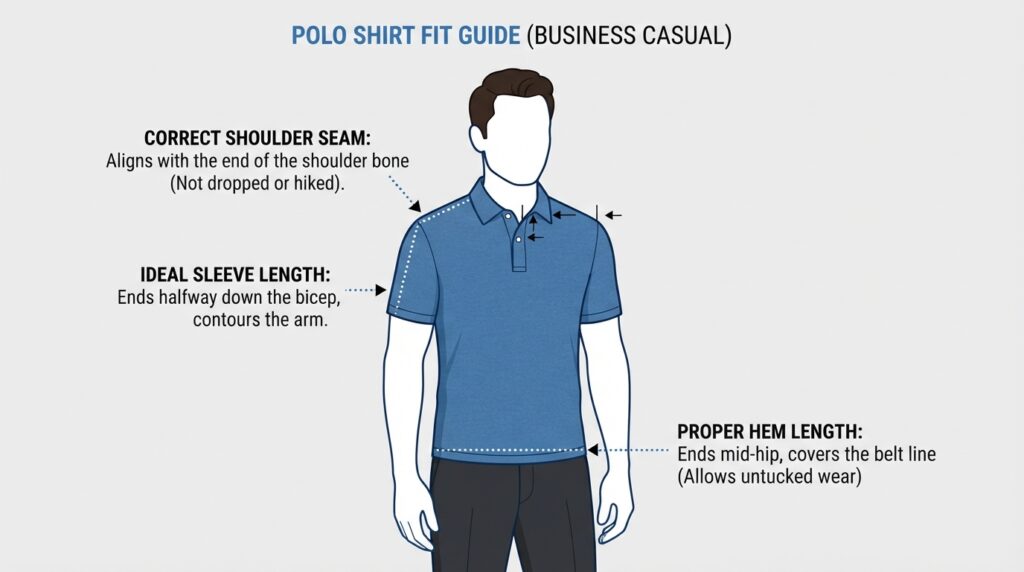
Fabric sets the foundation, but fit is what most people actually notice first. A well-fitted polo can elevate an entire outfit, while a poorly fitted one undermines even the nicest fabric.
A few fit checkpoints worth running through before you buy or wear a polo to work:
- Shoulders: The shoulder seam should sit right at the edge of your shoulder, not drooping down your arm.
- Sleeves: They should end roughly at the midpoint of your bicep, not flapping loosely or gripping too tight.
- Torso: There should be a slight taper, enough room to move without excess fabric bunching at the sides.
- Length: The hem should fall just below the waistband, long enough to stay tucked (if tucking) but not so long it looks like a dress.
- Collar: It should lie flat and hold its shape rather than curling or looking limp by midday.
If you’re between sizes, sizing down slightly usually photographs and reads better in professional settings than sizing up, as long as you can still move comfortably.
Color Choices That Read as Professional
Color does a lot of quiet work in an outfit. It’s often the difference between a polo that looks like weekend gear and one that looks like it belongs in a client meeting.
Stick to a core rotation of colors that consistently photograph as professional:
- Navy
- White
- Charcoal or heather gray
- Black
- Muted olive or forest green
- Soft burgundy
Brighter tones aren’t automatically off-limits. A rich blue or a deep emerald can work well as long as everything else in the outfit stays neutral. The mistake to avoid is stacking a bold polo with bold patterned trousers or busy accessories, since that combination tips the whole look toward casual weekend territory rather than office-ready.
Patterns are similarly fine in moderation. Thin stripes, subtle color-blocking, or tonal texture are generally safe. Large logos, cartoonish graphics, or loud novelty prints are not, regardless of how nice the fabric feels.
What to Pair With a Polo Shirt for the Office
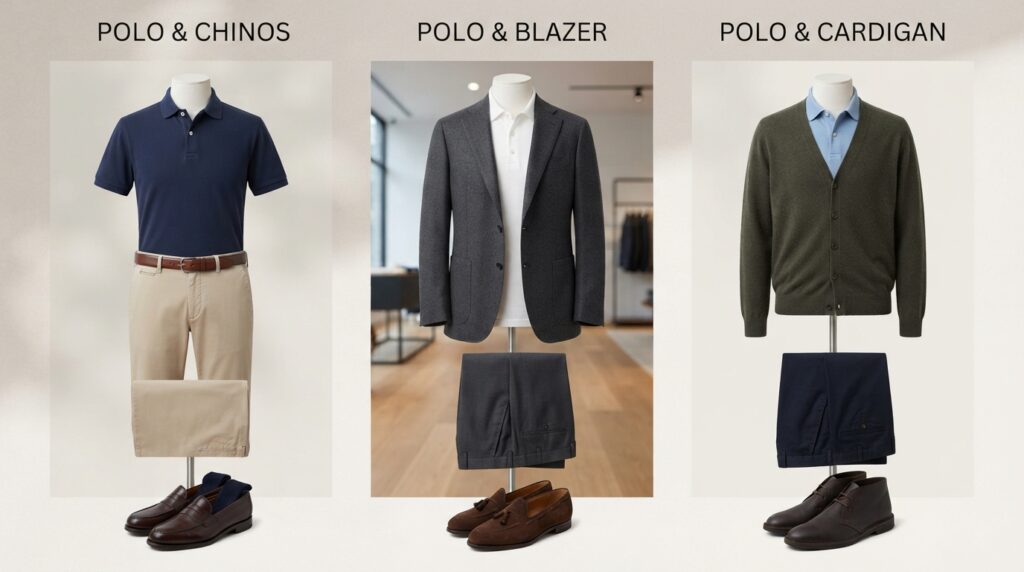
A polo shirt rarely works alone. What surrounds it, the trousers, shoes, and any layering pieces, does a lot of the heavy lifting in determining whether the whole outfit reads as business casual or weekend casual.
Bottoms That Work
Chinos and tailored trousers are the most reliable partners for an office polo. Dark denim can work in more relaxed business casual environments, but it’s worth checking your specific workplace norms first since some offices still treat any denim as too casual. Avoid cargo pants, athletic joggers, or shorts in most professional settings.
Shoes That Complete the Look
Loafers, clean leather sneakers, Oxfords, and derby shoes all pair naturally with a polo. Steer clear of flip-flops, worn-out athletic sneakers, or sandals, even in more relaxed offices, since footwear is often the detail that quietly undercuts an otherwise solid outfit.
Layering for Cooler Days or Dressier Moments
When temperatures drop or the meeting calls for a slightly more polished look, layering is the easiest upgrade:
- A structured blazer over the polo instantly formalizes the outfit
- A quarter-zip sweater or cardigan worn over the polo with the collar popped out adds texture
- A lightweight overshirt or jacket works for commuting between a casual and slightly dressier setting
Tucked or Untucked?
Both can work, but tucking generally reads as more polished, especially with a belt that matches your shoe color. If you go untucked, choose a polo with a slightly shorter, structured hem so it doesn’t look like it’s meant to be tucked but was forgotten.
How Industry and Workplace Culture Shift the Rules
Business casual doesn’t mean the same thing at a law firm as it does at a design studio, and polos sit right at the center of that variation.
| Industry | Polo Suitability | Notes |
| Tech and startups | High | Often the default, especially in solid colors |
| Education | High | Common with khakis and loafers |
| Creative agencies | Moderate to High | Room for bolder colors and patterns |
| Finance and law | Low to Moderate | Usually safer under a blazer, if allowed at all |
| Healthcare admin | Moderate | Solid colors, minimal branding preferred |
| Client-facing sales | Moderate | Depends heavily on the specific client and meeting |
Career guides that break down business casual attire across different industries consistently point out that education and creative fields tend to embrace polos more readily, while finance and law lean toward stricter interpretations of the dress code. When in doubt, it’s worth reviewing your company’s written dress code policy or simply observing what senior colleagues in similar roles tend to wear.
Common Mistakes That Make a Polo Look Too Casual
Even a great polo shirt can tip into “weekend errands” territory if a few small details go wrong. Watch for these:
- Wearing it too big. An oversized polo loses all structure and reads as loungewear.
- Choosing athletic or moisture-wicking fabric for the office. It’s built for the gym, not the boardroom, and the sheen often gives it away.
- Stacking loud colors or patterns. One statement piece is fine; two competing ones is not.
- Pairing it with shorts or flip-flops. Even the most relaxed office rarely embraces this combination.
- Letting the collar go limp. A worn-out, floppy collar signals an old or low-quality shirt.
- Skipping the iron. Knit fabric wrinkles differently than woven shirts, but visible creases still read as unkempt.
- Ignoring the workplace norm entirely. Culture matters more than any general style rule; a “should” from a guide still bends to what your actual office does daily.
Avoiding these mistakes usually matters more than any single styling trick, since they’re the details that quietly signal effort (or the lack of it) at a glance.
Building a Small Rotation Without Overspending
You don’t need a closet full of polos to make this work. A small, well-chosen rotation covers most business casual needs.
A practical starting lineup:
- One white pique polo
- One navy pique polo
- One charcoal or gray polo
- One muted accent color (olive, burgundy, or deep blue)
From there, two or three pairs of well-fitted chinos or trousers in neutral tones (navy, khaki, gray) and a single pair of versatile leather shoes can mix and match into more than a dozen distinct outfits. Quality tends to matter more than quantity here since a well-made pique polo holds its shape and color through repeated washes far better than a cheaper blend.
Expert Tips for Getting It Right Every Time
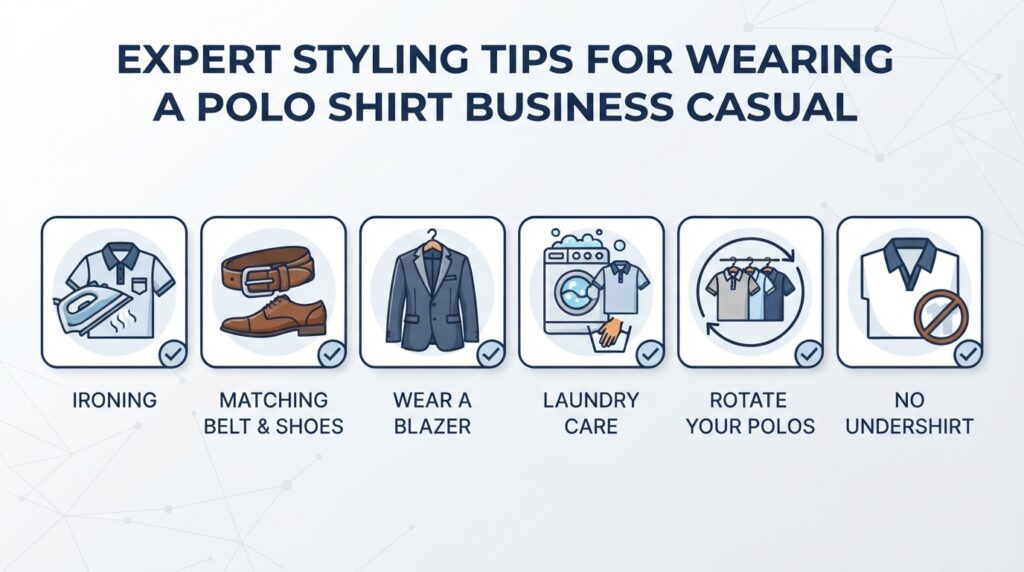
A few small habits separate people who consistently look polished from those who are just guessing:
- Iron or steam before wearing. Pique fabric hides wrinkles better than a dress shirt, but it doesn’t hide them completely.
- Match your belt to your shoes. It’s a small detail, but it’s one of the fastest ways to look intentional rather than thrown together.
- Keep one blazer on hand at the office. It instantly upgrades a polo for an unplanned client meeting.
- Rotate your polos to extend their life. Pique cotton can lose shape if worn and washed too frequently without rest between wears.
- Wash inside out in cool water. This helps preserve the raised texture and color of pique fabric longer.
- Skip the undershirt in most cases. A polo is already a layer; adding a visible undershirt collar underneath usually looks bulky rather than polished.
None of these tips require a big wardrobe investment. They’re mostly about maintenance and small styling choices that compound over time.
Pros and Cons of Choosing a Polo for Business Casual
| Pros | Cons |
| Comfortable and breathable for long days | Not accepted in stricter formal offices |
| Easier to care for than dress shirts | Can look sporty if fabric or fit is wrong |
| Works across seasons with the right layering | Limited formality ceiling, even with a blazer |
| Bridges casual and professional easily | Quality varies widely between brands |
| Widely accepted across many industries | Requires more restraint with color and pattern |
Weighing these side by side usually makes the decision easier. If your workplace already leans casual and comfort matters as much as polish, a polo is a strong everyday choice. If your role involves frequent client-facing formal meetings, it’s worth treating the polo as a backup option rather than a daily uniform.
Frequently Asked Questions
Is a polo shirt considered business casual for a job interview?
It depends on the company, but for most business casual interviews, a polo is a safer choice only if it’s paired with tailored trousers, closed-toe shoes, and ideally layered under a blazer. If there’s any uncertainty about the company’s dress code, a button-down shirt is generally the safer default for an interview specifically.
Can I wear a polo shirt with jeans and still call it business casual?
In more relaxed offices, dark, non-distressed jeans paired with a fitted polo and clean shoes can pass as business casual. In stricter environments, it’s safer to swap jeans for chinos or tailored trousers instead.
What color polo is safest for the office?
Navy and white are the two safest starting points since they pair with nearly any trouser color and rarely clash with other pieces in an outfit.
Should a polo shirt be tucked in for a business casual look?
Tucking generally looks more polished, especially with a matching belt, but a slightly shorter, structured hem can also look intentional when left untucked.
Is a long-sleeve polo more formal than a short-sleeve polo?
Generally yes. A long-sleeve polo, especially in a fine knit, can look closer to a dress shirt and works well layered under a blazer or sweater in cooler months or more formal business casual settings.
Bringing It All Together
So, is a polo business casual? In most modern offices, yes, as long as the fabric has structure, the fit is clean, and the rest of the outfit stays intentional rather than accidental. The polo’s sporty origins don’t disqualify it from professional settings; they’re actually what give it the built-in structure that makes it work.
The real decision point isn’t the garment itself. It’s the details around it: fabric choice, fit, color restraint, and what you pair it with. Get those right, and a polo shirt can carry you comfortably through most business casual days, from a Tuesday at the desk to an unplanned meeting that suddenly calls for a blazer.
If you’re building out a business casual wardrobe, start small. Pick up one or two well-made pique polos in navy and white, pair them with a solid pair of chinos, and build outward from there as you learn what your specific workplace actually expects.