
Calves are the one muscle group most people train wrong, or don’t train at all. They get a few rushed reps at the end of leg day, if that, and then everyone wonders why the rest of the leg grows but the lower leg stays flat.
The good news is you don’t need a gym to fix that. A handful of well-chosen calf workouts at home can build real strength and shape, using nothing more than a stair, a wall, and your own bodyweight. This piece walks through the muscles you’re working, the best exercises to do without equipment, how often to train, and the small form details that separate a wasted set from a productive one.
Why Calves Are So Hard to Grow
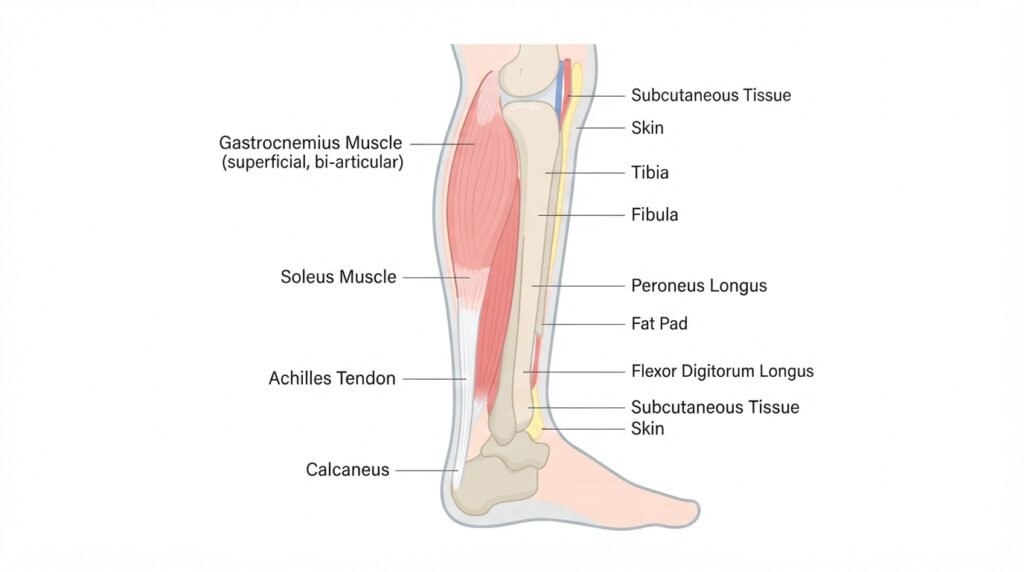
Before jumping into exercises, it helps to understand what you’re actually training. The lower leg isn’t one muscle — it’s a team.
Your calf muscle is made up of two main parts: the gastrocnemius, the larger muscle that gives the calf its visible shape, and the soleus, a flatter muscle underneath it that does most of the work during walking, standing, and long periods on your feet. Both muscles come together at the Achilles tendon.
That split matters for training. The gastrocnemius crosses the knee joint, so it’s most active when your leg is straight. The soleus doesn’t cross the knee, so it stays engaged even when your knee is bent — which is why seated and standing calf raises feel so different even though they look similar.
Calves also get less attention because they’re used constantly throughout the day just to keep you upright. That constant low-level activity makes them resistant to fatigue, but it also means casual movement rarely stimulates real growth. You need direct, focused work to see a change.
What You Actually Need to Get Started
One of the best things about training calves at home is how little setup it takes. There’s no machine that does this movement better than your own bodyweight and a bit of gravity.
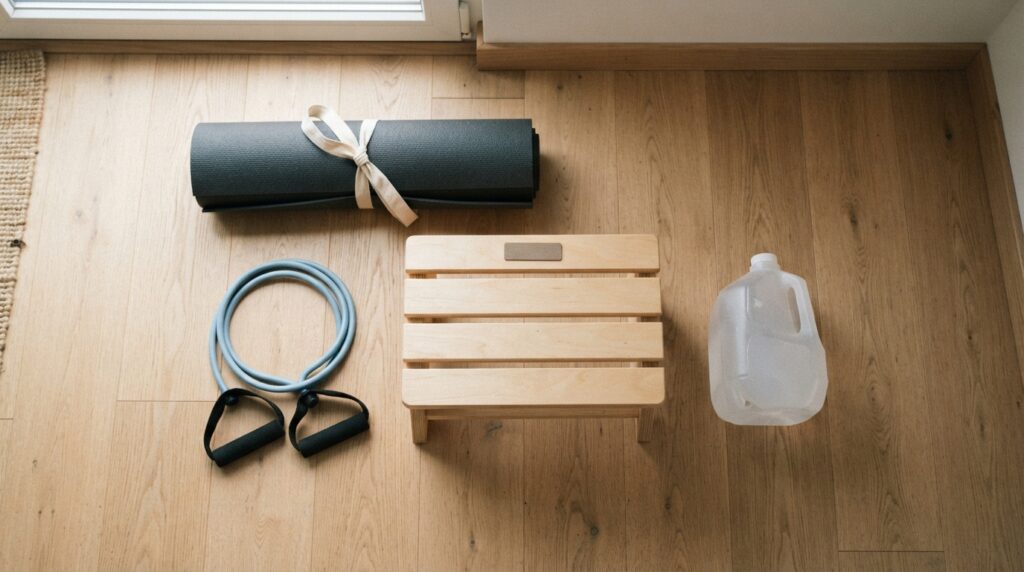
Here’s a short list of things that help, though none are required:
- A step, stair, or slightly raised curb for extra range of motion
- A wall or sturdy chair to hold for balance
- A resistance band for added tension once bodyweight feels easy
- A yoga mat or firm rug for seated variations
- A pair of light dumbbells or filled water jugs if you want extra load later
If you have none of this, that’s fine too. Every exercise below can be done on flat ground with nothing but your own body.
Warming Up Before Calf Work
Calves take a lot of daily wear, so skipping a warm-up is one of the fastest ways to end up with a tight Achilles or a strained muscle the next morning.
A short warm-up before your session should include:
- Two to three minutes of light movement — marching in place, easy jogging, or jumping jacks
- Ankle circles, ten in each direction per foot
- A slow bodyweight calf raise, two sets of fifteen, done with no added resistance
This doesn’t need to take more than five minutes, but it makes a noticeable difference in how the working sets feel.
Best Calf Exercises Without Equipment
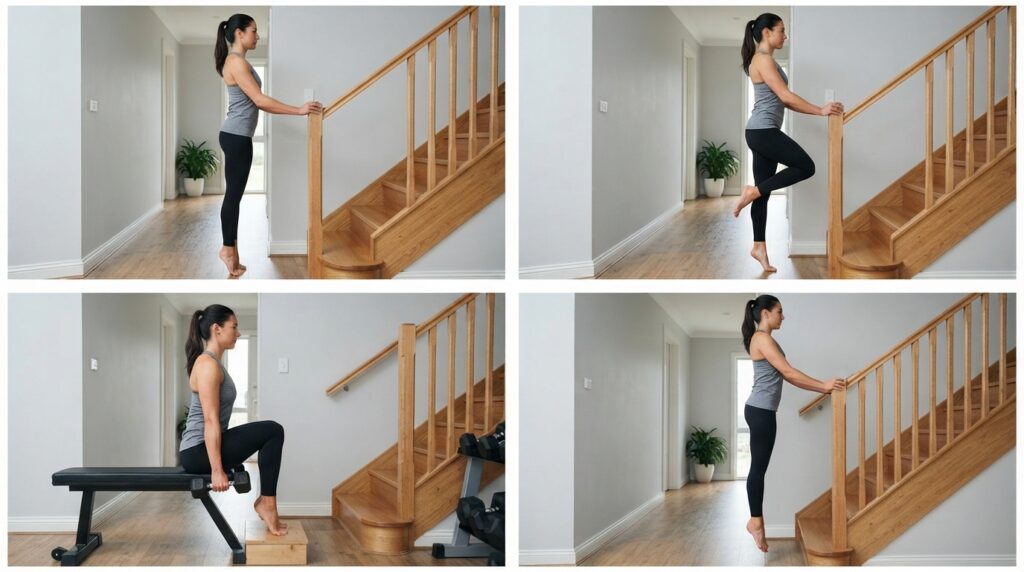
These are the core movements worth building a routine around. Each one targets the calves slightly differently, so mixing several into one session covers both the gastrocnemius and the soleus.
Standing Calf Raises
This is the foundational move, and for good reason — it’s simple, it’s effective, and it directly targets the gastrocnemius.
Stand with feet hip-width apart, near a wall for light balance support if needed. Rise up onto the balls of your feet as high as you can, pause for a second at the top, then lower back down slowly. Aim for two to three sets of fifteen to twenty reps.
To make it harder without any equipment, slow the lowering phase down to a count of three or four seconds. That extra time under tension does a lot of the work that added weight would otherwise do.
Single-Leg Calf Raises
Once double-leg raises start feeling easy, switching to one leg at a time roughly doubles the resistance instantly, since your full bodyweight now rests on a single foot.
Hold a wall or chair for balance, lift one foot slightly off the ground, and perform the raise on the standing leg. Two to three sets of ten to twelve reps per side is a solid starting point.
Calf Raises on a Stair or Step
Doing the movement on an elevated surface extends the range of motion, letting the heel drop below the level of the toes at the bottom of each rep. That extra stretch has been shown to meaningfully improve calf hypertrophy compared to a shorter range of motion, according to research summarized by StrengthLog.
Stand on the edge of a step with just the balls of your feet on the surface, heels hanging off the back. Lower your heels below the step for a deep stretch, then press up onto your toes as high as possible.
Seated Calf Raises
Bending the knee shortens the gastrocnemius and shifts more of the work onto the soleus, which is why seated variations feel completely different from standing ones.
Sit on a chair or the edge of a bed with feet flat on the floor. Place your hands on your knees for light downward pressure if you want more resistance, then raise your heels as high as you can and lower slowly. Two to three sets of fifteen to twenty reps works well here.
Donkey-Style Calf Raises
This variation hinges the hips forward, which changes the loading angle slightly compared to standing straight up. Bend forward at the hips, resting your forearms on a countertop or the back of a couch for support, and perform the raise from that hinged position. It’s a small tweak, but it hits the muscle from a slightly different line of pull.
Jump Rope and Pogo Hops
For anyone who wants a more athletic, explosive angle on calf training, jump rope or simple pogo-style hops in place build power and endurance at the same time. Keep the knees soft and let the movement come mostly from the ankles rather than bending deeply at the knees. Start with thirty to sixty seconds per set and build up gradually.
Resistance Band Calf Presses
If you own a light resistance band, seated calf presses add a new stimulus without needing dumbbells. Sit with your leg extended, loop the band around the ball of your foot, and press your toes away from you against the band’s tension, then return slowly.
A Simple Weekly Calf Workout Plan
Consistency matters more than intensity when you’re just getting started. Here’s a sample three-day split that fits easily around any other training you’re doing, or works as a standalone routine.
| Day | Exercises | Sets x Reps |
|---|---|---|
| Day 1 | Standing calf raises, seated calf raises | 3 x 15-20 |
| Day 2 | Rest or light stretching | — |
| Day 3 | Single-leg calf raises, stair calf raises | 3 x 10-12 per side |
| Day 4 | Rest | — |
| Day 5 | Donkey-style raises, jump rope intervals | 3 x 15-20, 5 x 30 sec |
| Day 6-7 | Rest or active recovery | — |
Training calves two to three times per week with a day of rest between sessions tends to produce steadier progress than cramming everything into one long workout, since the muscle needs time to recover between bouts of direct loading.
How Often Should You Train Calves at Home
This is one of the most common questions, and the honest answer is that calves tolerate more frequent training than most other muscle groups because they’re built for endurance and handle daily use well.
That said, more frequent doesn’t mean unlimited. A useful rule of thumb:
- Beginners: two sessions per week, focusing on form over intensity
- Intermediate: three sessions per week, mixing straight-leg and bent-knee variations
- Advanced or athletes: up to four sessions per week, provided recovery and Achilles comfort stay on track
If your calves feel unusually tight, sore for more than two days, or painful near the Achilles tendon, that’s a signal to scale back frequency rather than push through it.
Common Mistakes That Slow Progress
A few small errors show up again and again in home calf training, and fixing them tends to make a bigger difference than adding more sets.
- Bouncing through reps instead of controlling the movement, which shifts the work onto momentum rather than the muscle
- Cutting the range short by not dropping the heels fully at the bottom of each rep
- Skipping the pause at the top, where a brief hold increases time under tension
- Ignoring the soleus by only doing standing raises and never bending the knee
- Training through sharp pain, especially near the Achilles, instead of resting and reassessing
Small technical fixes like these usually matter more than the total number of reps performed.
Stretching and Recovery for the Calves
Because the calves work almost every time you stand or walk, they tend to get tight even without heavy training. A short stretching routine after each session helps keep them mobile.
Try a simple wall calf stretch: stand facing a wall, step one foot back, keep that heel pressed into the floor, and lean gently forward until you feel a stretch through the back of the lower leg. Hold for twenty to thirty seconds per side, and repeat with a slight knee bend to reach the deeper soleus muscle, a technique also recommended by WebMD for maintaining calf flexibility.
Foam rolling, if you have one available, can also help with soreness between sessions, though it isn’t a required part of the routine.
Expert Tips for Faster Results
- Slow the lowering phase of every rep down; the eccentric portion of a calf raise does a lot of the muscle-building work
- Rotate between straight-leg and bent-knee variations across the week rather than repeating the same exercise every session
- Train barefoot or in flat shoes when possible, since a raised heel in running shoes shortens the range of motion
- Track your reps and how deep your heel drops each week, since calves respond well to small, steady progression
- Give new soreness a few days before deciding whether frequency needs adjusting
Pros and Cons of Training Calves at Home
| Pros | Cons |
|---|---|
| No equipment required to get started | Harder to add heavy load long-term |
| Can be done almost anywhere, any time | Easy to skip without gym accountability |
| Low injury risk when form is controlled | Limited machine-based isolation options |
| Great for building daily consistency | Progress can plateau without resistance bands or weights |
Bodyweight training covers most of what a beginner or intermediate lifter needs. Once bodyweight raises feel genuinely easy for high reps, adding a resistance band or a couple of light dumbbells is usually enough to keep progress moving without needing a full gym setup.
Frequently Asked Questions
How long does it take to see results from calf workouts at home?
Most people notice improved strength and endurance within three to four weeks of consistent training, while visible size changes typically take longer, often eight to twelve weeks, depending on genetics, diet, and training frequency.
Can bodyweight calf raises really build muscle without weights?
Yes, especially for beginners. Slowing the tempo, using a deficit stair for extra range, and switching to single-leg work all increase the difficulty enough to keep driving progress well past the beginner stage.
Why do my calves feel tight after every workout?
Calves are used constantly throughout the day, so they tend to stay tighter than other muscle groups. Stretching after training and staying consistent with warm-ups usually reduces this over a few weeks.
Is it bad to train calves every day?
Daily light work, like mobility drills or short stretching sessions, is generally fine. Daily heavy training sessions, however, don’t leave enough recovery time and can raise the risk of Achilles irritation, so spacing harder sessions out is the safer approach.
What’s the difference between standing and seated calf raises?
Standing raises mainly target the gastrocnemius, the larger, more visible calf muscle, because the knee stays straight. Seated raises bend the knee, which shifts more of the workload onto the soleus underneath it.
Final Thoughts
Building stronger calves doesn’t require a gym membership or a rack of specialty equipment. A stair step, a wall for balance, and a few consistent sessions each week cover almost everything a beginner or intermediate lifter needs to make real progress.
Start with the basics, standing and seated raises, get the form right, then layer in single-leg work and deficit stretches as strength builds. Track your sets, give the muscle a couple of rest days between sessions, and stay patient. The calves respond well to consistency even when progress feels slow at first.
This article is for informational purposes only and is not a substitute for professional medical or fitness advice. Consult a doctor or certified trainer before starting any new exercise routine, especially if you have an existing injury or health condition.