
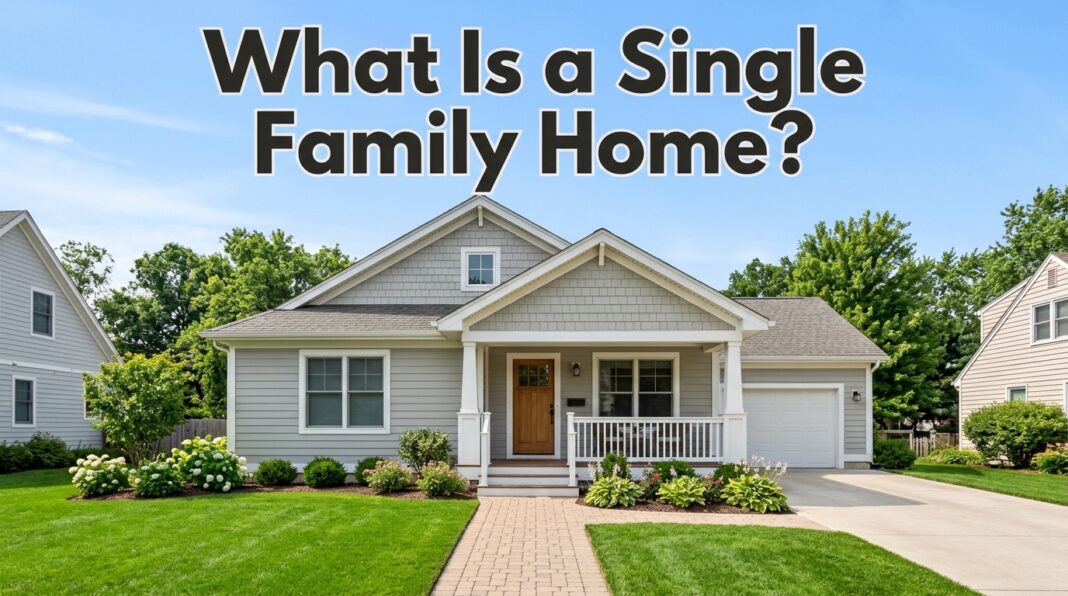
Scroll through any real estate listing site for more than a few minutes and you’ll run into the term over and over: single family home. It sounds simple enough, one house, one family, right? But the actual definition carries more weight than that, and it affects everything from your mortgage rate to whether you can legally rent out your basement.
So what is a single family home? At its core, it’s a standalone residential building designed to house one household, sitting on its own lot, with no shared walls, utilities, or land ownership with another home. That last part, the ownership piece, is where a lot of the confusion actually starts, since plenty of attached homes still technically qualify.
This guide breaks the term down the way a friend in real estate would explain it over coffee, plain language, real examples, and enough detail that you’ll never second-guess a listing description again.
The Core Definition, Broken Down Plainly
Strip away the jargon and the definition comes down to three things happening at once:
- One structure, one household. The building isn’t divided into separate units for different families.
- No shared walls. It’s physically detached from any neighboring structure, aside from its own garage or shed.
- Private land and utilities. The owner holds the title to both the house and the lot it sits on, and the home has its own independent plumbing, electrical, and HVAC systems.
That combination is what separates a single family home from an apartment, a duplex, or a condo, even when a listing photo makes two properties look nearly identical from the street. As one detailed comparison puts it, a single family home is a standalone residential structure built on its own parcel of land, giving the owner exclusive use of the entire property.
Why the Definition Actually Matters
This isn’t just a technical label real estate agents throw around. The classification shapes three practical parts of homeownership.
Financing. Lenders generally view single family homes as lower-risk loans compared to multi-unit or specialty properties, which can mean more favorable mortgage terms and a wider pool of loan programs to choose from.
Zoning and legal use. Local zoning ordinances often restrict single family residential lots to one household, meaning you typically can’t legally convert the home into a multi-unit rental without a zoning variance or a change in classification.
Resale value and appraisal. Appraisers compare a home against similar recently sold properties in the same category. A home marketed as single family but legally zoned differently can create headaches during appraisal or resale.
Detached vs. Attached: Where People Get Confused
Here’s the part that trips people up. A home doesn’t have to be physically detached to be legally classified as single family.
- Detached single family home: Free-standing on all sides, the most common image people picture.
- Attached single family home: Shares one or two walls with a neighboring unit but sits on its own individual lot, with the owner holding title to the land beneath it.
Townhouses are the clearest example of this second category. Even though the exterior walls connect to the neighbors on either side, each unit is separated by a floor-to-roof wall and situated on an individual lot, which is enough to qualify it as single family under most local definitions. Row houses in older cities often work the same way.
Common Types of Single Family Homes
Image prompt: A grid-style photograph collage showing four different single family home styles: a ranch house, a two-story colonial, a modern townhouse, and a modular home, clean daylight photography. Alt text: different types and styles of single family homes
Not every single family home looks the same, and the category actually spans a wide range of styles and construction methods.
| Type | Description |
|---|---|
| Detached house | Fully standalone structure, most common in suburban areas |
| Ranch style | Single-story layout, popular for accessibility and simplicity |
| Two-story or colonial | Multiple floors, common in older established neighborhoods |
| Townhouse | Shares one or two walls, individual lot ownership |
| Modular home | Built in sections off-site, assembled on location, often more cost-efficient |
| Manufactured home | Factory-built and transported to a permanent foundation site |
Each of these can technically fall under the single family umbrella, as long as the underlying criteria of one household, one title, and independent systems hold true.
Single Family Home vs. Multi-Family Home
This is the most common comparison people search for, and the distinction is fairly clean once you see it laid out.
- Single family home: One unit, one lot, one household, one owner of record.
- Multi-family home: A single building containing two or more separate living units, such as a duplex, triplex, or apartment complex, each with its own kitchen and bathroom but sharing one property title.
A two-story house with a fully separate apartment upstairs, complete with its own kitchen and entrance, would actually be classified as multi-family, even though it looks like an ordinary house from the curb. That’s a distinction worth double-checking before buying, especially if you’re planning to live in one part and rent the other.
Single Family Home vs. Condo
Condos get lumped into the same conversation constantly, but the ownership structure is fundamentally different.
With a single family home, you own the structure and the land underneath it outright. With a condominium, you own the interior of your individual unit, while the building’s exterior, land, and shared amenities are collectively owned by all unit owners through a homeowners association. That’s why condo buyers pay monthly association dues covering shared maintenance, something single family homeowners generally don’t deal with unless their neighborhood has its own separate HOA.
The Government’s Definition vs. the Everyday Definition
Most people picture a detached house with a yard when they hear the term, but government agencies and lenders often use a slightly broader definition for statistical and regulatory purposes.
That broader definition typically includes row houses and townhomes that meet the ground-to-roof wall separation standard mentioned earlier, alongside fully detached houses. The practical upshot is that a property can be legally and financially classified as single family without being a standalone structure at all, which is worth remembering the next time a listing description feels contradictory.
Pros and Cons of Owning a Single Family Home
Like any property type, this one comes with real tradeoffs worth weighing before you commit.
Advantages:
- Full ownership of both structure and land
- More privacy with no shared walls in most detached versions
- Freedom to renovate, landscape, or expand without a shared board’s approval
- Typically stronger long-term appreciation in many markets
- More space overall, including yard and storage areas
Disadvantages:
- Higher upfront purchase price compared to condos in many markets
- Full responsibility for exterior maintenance, roofing, and landscaping
- Property taxes and insurance costs tend to be higher
- No shared amenities unless the neighborhood has its own HOA
Weighing these against your budget, lifestyle, and how much maintenance you’re genuinely willing to take on tends to be the real deciding factor, more than the label itself.
Who Tends to Choose a Single Family Home
This property type consistently draws a specific mix of buyers. Growing families looking for extra bedrooms and yard space are the most obvious group, but it’s far from the only one.
Remote workers who want a dedicated home office without shared-wall noise, retirees looking to downsize into a smaller detached home rather than an apartment, and real estate investors seeking single family rentals for their stability and lower tenant turnover all show up in this category regularly. If you’re weighing whether this property type fits your own situation, thinking through your five-year plan, not just your current needs, tends to clarify the decision fast.
What to Check Before Buying One
A few practical checks matter more here than the general “is this the right style” question:
- Confirm the zoning classification with the local planning department, especially if you’re considering adding an accessory dwelling unit later.
- Check for HOA restrictions, since some single family neighborhoods still have community rules around exterior changes or rentals.
- Review the property survey to confirm exact lot boundaries, particularly for attached single family homes like townhouses.
- Ask about utility separation, confirming that water, electric, and gas are fully independent from any neighboring structure.
- Budget for full maintenance responsibility, since there’s no shared association covering roof repairs or landscaping unless one specifically exists in that neighborhood.
If you’re getting ready to sell a home like this down the line, the same fundamentals that make it attractive to buy, privacy, space, and full ownership, are usually the same points worth highlighting when it’s time to prepare the property for a fast, competitive sale.
Expert Tips for First-Time Buyers
- Get pre-approved before house hunting so you know your realistic price range for this property type in your target area.
- Factor in property taxes early, since rates vary significantly by county and can meaningfully change your monthly budget.
- Don’t skip the inspection, even on newer construction, since foundation and drainage issues are common on individual lots.
- Ask directly whether a listed “single family” property has any additional dwelling units on the lot, since that can affect both financing and future resale.
- Compare insurance quotes from a few providers, since coverage costs for detached homes can vary more than people expect.
Frequently Asked Questions
Is a duplex considered a single family home?
No. A duplex contains two separate living units within one structure, which classifies it as multi-family, even though it might look like a single house from the street.
Can a single family home have an in-law suite?
Generally yes, as long as the suite doesn’t include a fully separate kitchen and legal second address, since that combination can push the classification into multi-family territory depending on local zoning rules.
Are townhouses single family homes?
In most jurisdictions, yes. Even though they share walls, townhouses typically sit on individual lots with private ownership of the land, which meets the standard single family criteria.
Is a manufactured home a single family home?
Yes, as long as it’s permanently affixed to a foundation on its own lot and houses one household, a manufactured home is generally classified alongside other single family properties.
What’s the difference between single family and single family attached?
Single family detached means no shared walls at all. Single family attached refers to homes like townhouses that share one or two walls but still meet the individual lot ownership and household criteria.
Bringing It All Together
The term single family home covers more ground than most people expect walking into their first house hunt. It’s less about whether the walls touch a neighbor’s and more about ownership, land, and how many households actually live under that roof. Once that distinction clicks, reading listings, comparing mortgage options, and understanding your local zoning rules all get noticeably easier. Whether you’re buying your first place or just trying to make sense of a confusing listing description, that one clarification usually answers most of the follow-up questions before they even come up.